
Guest blog from Farjana Akter, VOICE, Bangladesh
Climate changes have massively influenced the life of millions of people all over the world. In South Asia Bangladesh is the most affected country. Increased rainfall, droughts, changes in the monsoon pattern, recurring floods and warm winters are all obvious syndromes of climate change. In the past year terrible cyclone Sidr damaged 8.9 million peoples life in Bangladesh. Sea level rise over the last ten years has already eroded 65 per cent of the landmass of the islands of Kutubdia (250 square kilometers), Bhola (227 square kilometers) Sandwip (180 square kilometers) (NCCB).
In the negotiations Bangladesh has been trying to play a vital role as a disaster prone country. Bangladesh demanded to set-up an International Adaptation Centre in Dhaka under the UN framework. The main objective of the centre would be research on how to adapt to climate change.
Bangladesh has asked for a climate change fund, under the UNFCC, which must be in addition to the existing official development assistant commitments made by rich countries of 0.7 percent of gross national product. Bangladesh also demanded that contributions to the Fund must be mandatory not voluntary. Such funds are needed as compensation from rich countries for the climate damage they have caused.
The Bangladesh delegation also asked for developing a mechanism, with the help of the Intergovernmental Panel on Climate Change, to create an index on the vulnerability of people in each country to climate change.
Bangladesh included the "international migration issue" on the agenda of one of the contact group discussions. They sought to get countries to agree that climate change victims will get the chance of international migration if their homes are destroyed by climate change.
Developing countries are less responsible for climate change but are suffering most from the adverse impacts. All countries must agree to an international cap on emissions. Developed countries have to commit to take the lead in making technology cheaper and transferring it to developing countries.
We have to wait a few more days to see the final outcome of the Poznan convention. Developed countries must show support for climate justice and a fair negotiation within the convention framework.
At Poznan, we call on Parties to ensure equity and justice for all the people in different countries who are already displaced from their homes and livelihoods due to climate change.
Thursday, 11 December 2008


Guyana
An old acquaintance of WDM was speaking at the opening of the ministerial part of the talks on Thursday morning: Bharrat Jagdeo, the President of Guyana. In 2003, WDM and a group of penguins successfully campaigned for the supermarket chain Iceland to cancel £12 million of illegitimate debt ‘owed’ to them by Guyana. President Jagdeo personally thanked two WDM staff somewhere in Heathrow airport.
The heads of government of Poland, Sweden and Tuvalu are here as well. Apisai Ielemia, President of Tuvalu, said: “Recent scientific evidence suggests that we must move rapidly for the future existence of countries like Tuvalu. Our future is in your hands. We must not sink by the problems caused by the big and industrialised countries. It is our belief that Tuvalu as a nation has a right to exist forever.”
Bharrat Jagdeo stated that “as an international community our efforts are woefully inadequate to the challenge we face”. With a message straight to European heads of government meeting in Brussels on Thursday and Friday he said: “If Europe sends a signal they can commit to deep cuts in emissions only in prosperous times, what are developing countries supposed to think?”
The heads of government of Poland, Sweden and Tuvalu are here as well. Apisai Ielemia, President of Tuvalu, said: “Recent scientific evidence suggests that we must move rapidly for the future existence of countries like Tuvalu. Our future is in your hands. We must not sink by the problems caused by the big and industrialised countries. It is our belief that Tuvalu as a nation has a right to exist forever.”
Bharrat Jagdeo stated that “as an international community our efforts are woefully inadequate to the challenge we face”. With a message straight to European heads of government meeting in Brussels on Thursday and Friday he said: “If Europe sends a signal they can commit to deep cuts in emissions only in prosperous times, what are developing countries supposed to think?”
Wednesday, 10 December 2008
The 69th day
Members of the European Parliament held a press conference on Wednesday. They wanted to make clear that if the EU’s climate policy is weakened over the next couple of days it will be nothing to do with them.
Of course not. They are only elected representatives.
EU Heads of Government will be meeting on Thursday and Friday to agree the final package on reducing emissions within Europe up to 2020. At the moment it looks like between half and two-thirds of the target for reducing emissions by 2020 could be achieved through buying offsets rather than cutting emissions in the EU.
MEPs want a limit on offsets, but governments are not listening. The UK has supported half of the EU’s reductions being made through offsets.
On Thursday environment ministers arrive in Poznan and the pace is expected to quicken. Ed Miliband will be here for the UK, fresh faced just 69 days into his new job of Secretary of State for Energy and Climate Change.
There are three things Ed could say in his speech on Thursday to inject a bit of life and leadership into Poznan, something which has so far been invisible from rich countries.
1) Accept the advice from his own Committee on Climate Change, given last Monday, that UK emissions need to fall by 42 per cent on 1990 levels by 2020.
2) Say that the UK will offer money to support cuts in emissions in developing countries, in addition to cuts at home. The EU has failed to engage at all with developing countries on this issue in Poznan, saying it will be working on proposals in the first three months of 2009. An opportunity for Ed to take a lead.
3) More immediately, funds are needed in the next few years to help communities in poor countries cope with impacts of climate change already being experienced.
National plans in 38 least developed countries have identified ₤1 billion is needed over the next three years for concrete actions. Whilst tens of billions will be needed later on as the impacts of climate change get worse, the ₤1 billion is needed now.
Ed could come bearing a cheque with the UK’s contribution. Of course, it has to be additional to other aid funds, or its just robbing Peter to pay Paul.
Of course not. They are only elected representatives.
EU Heads of Government will be meeting on Thursday and Friday to agree the final package on reducing emissions within Europe up to 2020. At the moment it looks like between half and two-thirds of the target for reducing emissions by 2020 could be achieved through buying offsets rather than cutting emissions in the EU.
MEPs want a limit on offsets, but governments are not listening. The UK has supported half of the EU’s reductions being made through offsets.
On Thursday environment ministers arrive in Poznan and the pace is expected to quicken. Ed Miliband will be here for the UK, fresh faced just 69 days into his new job of Secretary of State for Energy and Climate Change.
There are three things Ed could say in his speech on Thursday to inject a bit of life and leadership into Poznan, something which has so far been invisible from rich countries.
1) Accept the advice from his own Committee on Climate Change, given last Monday, that UK emissions need to fall by 42 per cent on 1990 levels by 2020.
2) Say that the UK will offer money to support cuts in emissions in developing countries, in addition to cuts at home. The EU has failed to engage at all with developing countries on this issue in Poznan, saying it will be working on proposals in the first three months of 2009. An opportunity for Ed to take a lead.
3) More immediately, funds are needed in the next few years to help communities in poor countries cope with impacts of climate change already being experienced.
National plans in 38 least developed countries have identified ₤1 billion is needed over the next three years for concrete actions. Whilst tens of billions will be needed later on as the impacts of climate change get worse, the ₤1 billion is needed now.
Ed could come bearing a cheque with the UK’s contribution. Of course, it has to be additional to other aid funds, or its just robbing Peter to pay Paul.
Climate insurance for a dead man
 Guest blog from Farjana Akter, VOICE, Bangladesh
The adverse impacts of climate change are already threatening communities around the world. Over the last century the level of carbon dioxide has increased by 25 per cent. Developed countries are mainly liable for the climate crisis. And this problem is devastating environment and biodiversity, damaging people’s life and livelihoods around the globe. Climate change victims are increasing in number every day. It is alarming that there is no obligation for states to recognize the international and external displacement of people due to climate change and other environmental issues.
A study shows that 95 per cent of deaths from natural disasters in the last 25 years occurred in developing countries. And $100 billion has been lost every year due to these natural disasters. The communities of the developing countries are trying to cope with disasters. And the governments of developing countries are generating money for adaptation and mitigation programmes within their countries.
In the UNFCCC there is a vital discussion going on about adaptation and protection of vulnerable countries and people. The contact group on enhanced action on adaptation and associated means of implementation meeting was held yesterday. They were pushing the agenda of an insurance mechanism. The proposed insurance mechanism work to facilitate vulnerability reduction and adaptation. It means affected communities who die because of climate change will get insurance money! This insurance mechanism for vulnerable people is crazy - when people die, they lose their life. What will he/she do with the money!
First we need to think about reducing the risk of climate change – cutting emissions.
The other question is ‘who is going to pay for insurance’? There are many good proposals coming out from the discussion of the contact group. Most of the delegates emphasized an international disaster and management plan which would be integrated with national plans. The most vulnerable country in South Asia, Bangladesh, has had for ten years an Action Plan on Risk Reduction Management. Resource sharing, capacity building and food security reduce the disaster risk in Bangladesh.
Bangladesh asked for help establishing an early warning system about climate information so that they can reduce the risk of disaster in the community.
The meeting also discussed the need to address specific sectors. To manage disaster risk a rehabilitation center for developing countries needs to be established to help vulnerable people rather than insurance.
There is a need for North-South and South-South cooperation. South Africa emphasized the integrity and long term approach for risk management. Whereas Colombia urged for community based adaptation for risk management. Australia said national and domestic action as well international action was needed for adaption.
As the frequency and scope of major natural catastrophe losses continue to increase, there is a growing need to reduce the disaster risks associated with climate change. The market is pushing for insurance – but there are alternative ways developed countries can play their part in enabling disaster-prone countries to successfully manage the new climate risks.
Tuesday, 9 December 2008
Visible
 I brought quite a few books with me to Poznan in an attempt to stay sane. At the moment I am reading ‘Neverwhere’ by Neil Gaiman. Lent to me by Pete - WDM’s web maestro - it tells of a world where the marginalised fall through the cracks in London, and live beneath the streets of the city.
The marginalised of ‘London below’ are invisible to those living in ‘London above’. Unless directly confronted by them.
In a report released a couple of weeks ago (Carbon Evictions), WDM outlined how under current plans to tackle climate change, the UK will be responsible for forcing 10 million people to leave their homes due to climate change, through higher sea-level, stronger storms and more drought.
At a seminar on Monday night, Koko Warner from the United Nations University presented research about those already being displaced by climate and other environmental changes. The research shows that those forced to leave their homes because of climate change are and will be on average younger, older, poorer and ‘more-female’ than current refugees. They will be the most marginalised.
In negotiations on Tuesday several rich countries have sought to marginalise further many people across the world. The US, Canada, Australia and New Zealand insisted that references to protecting the ‘rights’ of indigenous and forest peoples be removed from any agreement on reducing emissions from deforestation.
The caucus of indigenous groups here in Poznan organised a spontaneous protest in response. The chants of ‘No rights’ blasted through the negotiations. The UN sent in security to shut the protest down. Hopefully the direct confrontation will have made the rights of indigenous and forest peoples more visible to the negotiations of the powers that be.
Monday, 8 December 2008
Allergies
What were you doing on Saturday evening? Watching X-factor? A relaxing meal after being on a climate protest? Drinking a beer and bemoaning Leeds’ defeat to Tranmere?
Fortunately or unfortunately I was participating in none of these, but instead joined the International Emissions Trading Association for an event on the future of the Clean Development Mechanism.
 Henry Derwent, President and CEO of the business lobby group IETA, chaired the meeting. Until last year Henry led the UK government delegation in climate negotiations, but obviously the UK’s support for carbon offsetting has had nothing to do with Henry being rewarded with his job at IETA.
There was wide-spread agreement in the room that there is a big problem that many CDM projects are not “additional”- they have done nothing to decrease emissions. Simon Marr from the European Commission said that 40 per cent of CDM projects are not additional to what would have happened without CDM funding.
Not that this should get in the way of emissions trading. One business delegate present said “I am reviled by the thought that because of issues around additionality we should abandon the CDM. By engaging with additionality issues we have increased transaction costs which has added to the burdens of business.”
Andrei Marcou from IETA told us that “The CDM has largely been successful” and that those opposed to the CDM “have an allergy to it”.
I have an exotic allergy to sheep and goats cheese. I am not sure of the comparison with the CDM, as reading about dodgy offset projects has not previously brought me out in huge swellings and rashes in the same way as a lump of feta will. However, by now I was getting exasperated if not asphyxiated.
None of the corporate speakers had made any reference to how the CDM and offsetting could help meet global targets for emissions reductions or limit the increase in global temperature to a certain level. There had been no consideration of climate change as a justice issue, or the negative impacts of climate change across the world.
I asked the panel to fill this gap: what is their vision of how we could keep global temperature increase to 2°C if rich countries continue to emit and reach their reduction targets through offsetting in poor countries?
The business people did not seem to understand the question. It was left to Simon Marr from the European Commission to declare that the need to cut emissions in the EU and support action in developing countries as well means that “offsetting has to stop”.
Hallelujah! Someone has seen the light!
But no. In conversation afterwards Simon did not regard the EU meeting half of its reduction targets through buying CDM credits as offsetting.
I may not be allergic to the CDM, but as my eyes puff up and the rashes develop on my arm, an illogical argument joins mediterranean cheeses on my list of things to avoid consuming.
Fortunately or unfortunately I was participating in none of these, but instead joined the International Emissions Trading Association for an event on the future of the Clean Development Mechanism.
 Henry Derwent, President and CEO of the business lobby group IETA, chaired the meeting. Until last year Henry led the UK government delegation in climate negotiations, but obviously the UK’s support for carbon offsetting has had nothing to do with Henry being rewarded with his job at IETA.
There was wide-spread agreement in the room that there is a big problem that many CDM projects are not “additional”- they have done nothing to decrease emissions. Simon Marr from the European Commission said that 40 per cent of CDM projects are not additional to what would have happened without CDM funding.
Not that this should get in the way of emissions trading. One business delegate present said “I am reviled by the thought that because of issues around additionality we should abandon the CDM. By engaging with additionality issues we have increased transaction costs which has added to the burdens of business.”
Andrei Marcou from IETA told us that “The CDM has largely been successful” and that those opposed to the CDM “have an allergy to it”.
I have an exotic allergy to sheep and goats cheese. I am not sure of the comparison with the CDM, as reading about dodgy offset projects has not previously brought me out in huge swellings and rashes in the same way as a lump of feta will. However, by now I was getting exasperated if not asphyxiated.
None of the corporate speakers had made any reference to how the CDM and offsetting could help meet global targets for emissions reductions or limit the increase in global temperature to a certain level. There had been no consideration of climate change as a justice issue, or the negative impacts of climate change across the world.
I asked the panel to fill this gap: what is their vision of how we could keep global temperature increase to 2°C if rich countries continue to emit and reach their reduction targets through offsetting in poor countries?
The business people did not seem to understand the question. It was left to Simon Marr from the European Commission to declare that the need to cut emissions in the EU and support action in developing countries as well means that “offsetting has to stop”.
Hallelujah! Someone has seen the light!
But no. In conversation afterwards Simon did not regard the EU meeting half of its reduction targets through buying CDM credits as offsetting.
I may not be allergic to the CDM, but as my eyes puff up and the rashes develop on my arm, an illogical argument joins mediterranean cheeses on my list of things to avoid consuming.
Saturday, 6 December 2008
Demonstration time
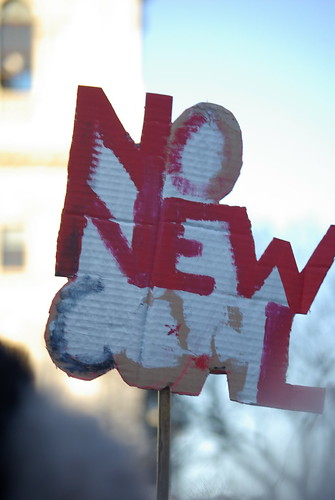 Saturday has been by far the best day in Poland so far. It was time to demonstrate.
Over 1,000 people marched through the streets of Poznan to the convention centre demanding urgent action now to prevent disastrous climate changes.
With my “Stop Kingsnorth” T-shirt I joined a group of people in Climate Justice Now! – a coalition of organizations from across the world, including WDM. With Benny from India, Juana from Cambodia and Ricardo from El Salvador we demanded “Climate Justice Now” and proclaimed “People, united, will never be defeated.”
But as the cold set in to our fingers and toes, eloquence hit a new low with the chant of “CDM… Boo”.
I knew that back in London friends and colleagues would also be marching, and felt a sense of that global action we need to tackle the climate crisis.
Returning to the conference centre, a journalist from Reuters asked me about the march. “Should someone have come to speak to you?”
Of course they should.
A delegate from the EU should have justified how we are going to tackle climate change if the EU meets over half its targets for reducing emissions through dodgy offset projects.
A delegate from the UK should have told us how we can tackle climate change whilst building new coal power stations and new runways.
It would have been refreshing for any country to tell us one thing they have done this week to move the world towards a just way of tackling climate change.
From the first week here it is clear that officials and ministers are not going to take the lead in getting us out of the climate crisis we are in. But then again, that’s always been our job, not theirs.
Subscribe to:
Posts (Atom)

 Posts
Posts

